Friday, April 27, 2012

More fun with dying

With Easter being just over, I had the brilliant(?) idea that a perfect way to control dying larger lots of yarn would be to use Easter egg dye.  Get it from the same company, and each color is going to be about the same from package to package.  So I gave it a shot.  Certainly dying same-tone yarn will be about the same, as long as approximately the same amount of yarn is to be dyed.  Variegating the yarn was harder to control, but fun!  The picture below is 120 yards of Lion Brand Fishermans Wool in the beginning of a Baby Surprise Jacket, and an attempt to duplicate the dying.  The pink/purple section is not the same, but I think it's probably closer than exact dye lots of Noro!  (Noro not being my favorite color combos!)

I'm in Colorado as I do this experiment.  After dying the yarn, I put it on the clothes drying rack out on the deck about 8 o'clock .  I came back 1 hour later to check on the state of drying, and discovered it frozen stiff!  Who knew wet things would freeze at 32 degrees!   ;-)


This has been so much fun, I think I'm going to try some tonal dying next.  And I realized, if you want a bright yellow, use Easter egg tabs!  The yellow I got here is vivid, and I had a lot of trouble getting a vivid yellow with KoolAid and other food-safe dyes.  Next I think I'll take a couple of the pink tabs and try graduating the depth of color from deep at the ends of the hank to less intense at the middle of the hank.  Should be fun .. or at least my idea of fun!  Many of my friends (and my husband, probably) don't understand my fascination with playing with fiber.  Oh well, they're the ones missing out!

Thursday, April 19, 2012

Surprise!

I made my first foray into the world of Elizabeth Zimmermann, a knitting genius often called the Knitting Goddess.  She was an impressive and analytical mind, a true knitting engineer.  She designed a concept known as the Baby Surprise Jacket, which has been adapted for adult sizes.  Those who have done the jackets always recommend starting with the BSJ, to understand the concept and for ease of scale before moving on to the ASJ. For Christmas, I got the Elizabeth Zimmermann book, The Opinionated Knitter (go figure me wanting that book!) which is a reprint of her newsletters from 1958-1968.  The newsletters were a quarter, back in the days of mimeograph machines, not blogs!  Her daughter took over her mother's legacy, and edited the book for republication. 

I started knitting the sweater Monday night, and finished it Thursday night.  Since it is all garter stitch, it's fairly mindless, and now that I know the concept, I'll be making this "car knitiing."

The sweater, before it is sewn up

Add 2 seams at the shoulders, and voila! Instant sweater.

Monday, April 2, 2012

Spinning and dying fun


After spinning a bobbin full of fiber and still having 4 ounces left out of my pound of roving, I decided to spin this up in a hurry and try some jacquard acid dye.  This is kelly green and I had such fun playing with it.  Now I have to  think of something to knit up with about 120 yards of worsted weight wool.  Any ideas?

After spinning up this fiber, I've decided I feel similarly about Romney in sheep and in candidates:  It'll pass in a pinch, but not my first choice!


My first lace shawl project was so fun, I've done three of them!  This is the Ashton shawlette, available at knittingparadise.com, where I ran into it.  The first was shawlette size in a sportweight handspun in bronze; the second is almost finished, but I need to find a little bit more of the sequined worsted weight yarn I found at Hobby Lobby in brown (or I'll finish it up with a matching or contrasting color on the points). I figure a more substantial weight shawl is good for Wyoming.  The third is my favorite, because I made it a full-sized shawl rather than a shawlette.  It is 52" wide and 26" top to points.  The yarn is Crystal Palace Panda Wool, in Bluebell.  I wanted to make something that will go with a lot of clothes.  However, I liked it so much, I'm likely to make it again in something where the yarn stars.  It truly knits up quick.  I started it at 1 p.m. on March 17, and finished it at 3 p.m. on March 25.

Stretched out so you can see the pretty pattern.  I need to get it blocked, but I couldn't wait to get the picture posted.
 Here I am modeling my newest creation!

Haven't been here in a while

March was a hectic month, and I feel like I missed it entirely!  However, I do have some fibering updates.  Today's helpful tip is about keeping track of rows in pattern repeats.  I just finished my third Ashton shawlette (pictures later, after they're blocked) and realized that it's incredibly easy to forget which pattern row you are working on, especially if you set the work down for some reason ... and who doesn't have a spouse, kids, the phone, or something that causes you to leave your work and have to pick it up and say, "Where in the world am I in the pattern?"  So here's my hint, complete with pictures:

Using the "safety pin" style stitch markers, I count how many rows or pattern rows are in a complete pattern and count out that number of safety pin markers.  When I get ready to start a new pattern row on a shawl, or a new row on socks that have a pattern, I move a marker from the "waiting to be knitted" marker to the "already been knitted" marker. When I have finished the complete pattern, I shift all the markers to the "waiting" spot and start again.  It has been hugely helpful on the Ashton shawlette (to which I added extra patterns to be a full-sized shawl) which has a 12 pattern row repeat.  On these socks, that have an 8-row pattern that rows 1 and 5 are different from the rest, I use the orange marker to designate row 1 so I always know which of the unique rows I'm doing.  On these socks I am supposed to increase one on each side of the sole every other row, so the markers also help me keep track of which one was an increase row.


(Obviously the flash was on in the top picture, which is closer to the color.)  You can see the orange marker all by hiimself, showing that I'm ready to start row 1 of the pattern, then there is a green marker joining him to remind me that I'm doing row 2.

Friday, February 10, 2012

Random handspun experiments

I picked up some wonderful alpaca to spin up.  It came out sooooo soft, I think I don't want to take a chance on messing up the softness by dying, so I'm trying to decide what to knit in the natural shade.  Since I tried various plies and various sizes, I'll have to knit something that will incorporate the variety.


During open spinning time at the shop where I bought my wheel and took a class, a lady showed me her locally grown (Fort Collins) and locally processed (Laramie Wyoming at UW) wool that was "rough processed."   I was so interested in trying other fibers that I bought 5 ounces from her ($1 an ounce, what a deal!)  In spinning it up, I had my first encounter with what is colloquially known as "vegetable matter" -- translation:  We didn't take too much time picking the leaves and thorns out of the fleece before we carded it.  This explains why at $1 an ounce, she was clearing profit on it -- they didn't spend much time on it.  It spun up fairly easily, but there's not much of it, so I'll probably use it to experiment with dying processes. ...... which is a blog for another time.

And here's my recliner, full of handspun.  Lots of fun with small samples.  So now I've begun a larger spinning project.  (more later)


Friday, February 3, 2012

What 4 ounces of fiber makes

In attempting to improve my spinning skills, I bought roving (carded fleece ready to spin) at the only place in Cheyenne that sells roving.  It was a limited selection, but it gave me the opportunity to get some success under my drive belt.  These, as well as the green hat posted earlier, are each from 4 ounce balls of Targhee sheep roving.  All the colors are more vivid in real life.  I can tell I am going to have to take my work outside to photograph!  So far I love spinning Targhee wool  It gets really good reviews as a beginning spinner fiber, because it drafts (pulls the fiber out in preparation for spinning) so well


 Bulky weight, pretty consistent. This was my third roving to spin up.
Thick and thin - my second spinning try

This is probably my most consistent fiber to date.  It is a lace-weight.  The knitting done there is on size 0 needles.  The color is much brighter red than the pic.

What's new, section three -- SPINNING

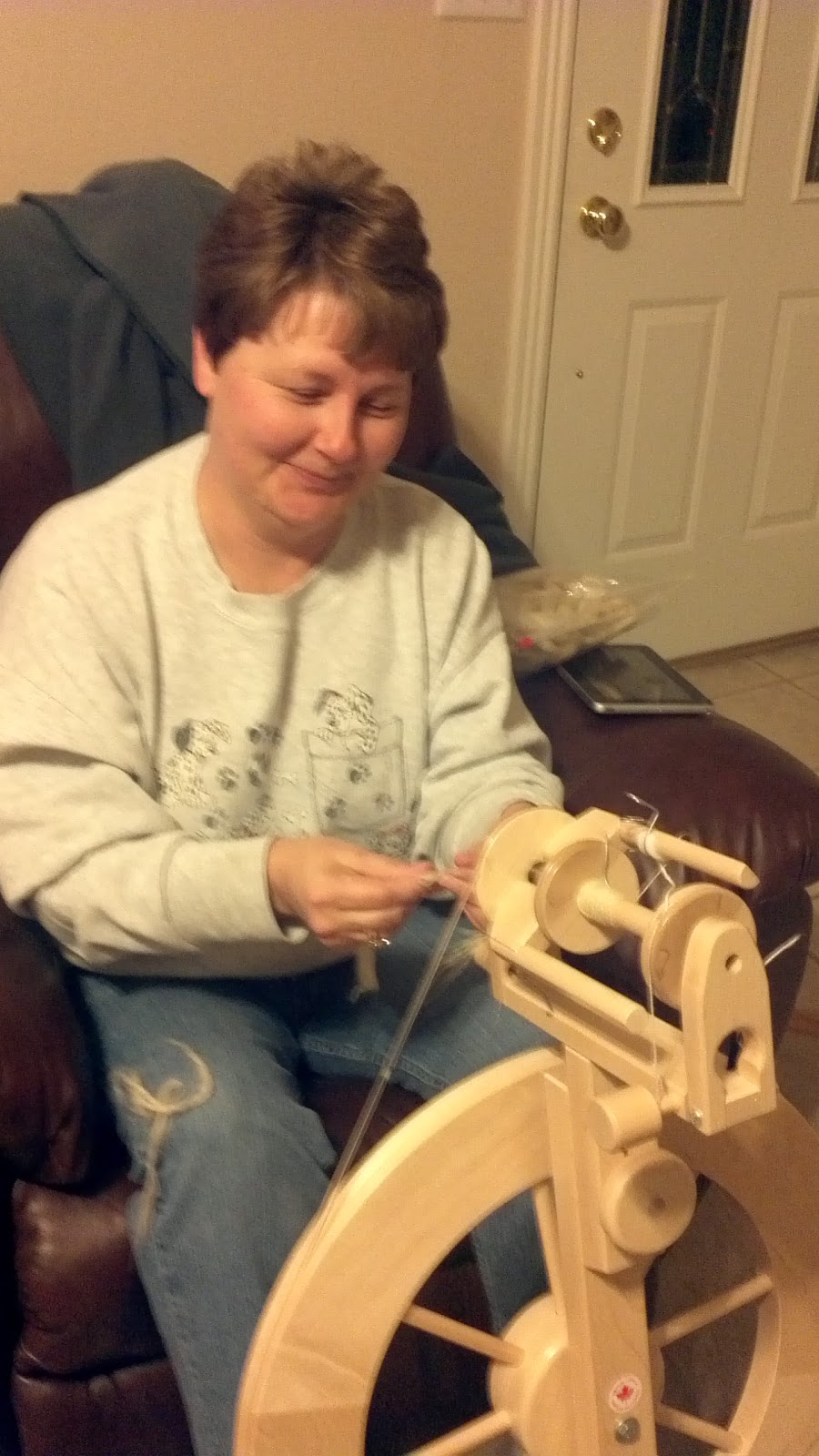
For my birthday last year, John got me a Lendrum spinning wheel.  I've always wanted to learn to spin.  One of my dear friends out here looked at it and said, "You know, they sell that *#%* in stores!"  And I do know that (as you can tell from my stash room!) but for me the interesting part of any of my crafting is in the creation, and the way you can make something totally different by changing one little aspect of the design.


I am enjoying learning to spin, but I'm still not very good at it.  My control of the size of strand (ply) is improving.  I can now spin medium-weight (sport to worsted sizes) fairly consistently.  I'd like to try now to do a thick-and-thin yarn, which is all I could manage in the beginning!  It was accidental then, so I'd like to try to do it on purpose.

This hat was knitted with my first handspun yarn.  It was spun on a drop spindle, then wheel plied.